
I first wrote this in Chinese. The original is here.
I compared Grok, Claude, and GPT
I tried Grok and Claude. The answer I trusted came from GPT.
Grok and Claude gave me generic lists. They sounded like they were talking to themselves, and the two answers were close to each other. I still could not tell where to start.
GPT listed categories too, but it scored them. SEO potential was one of the scores.
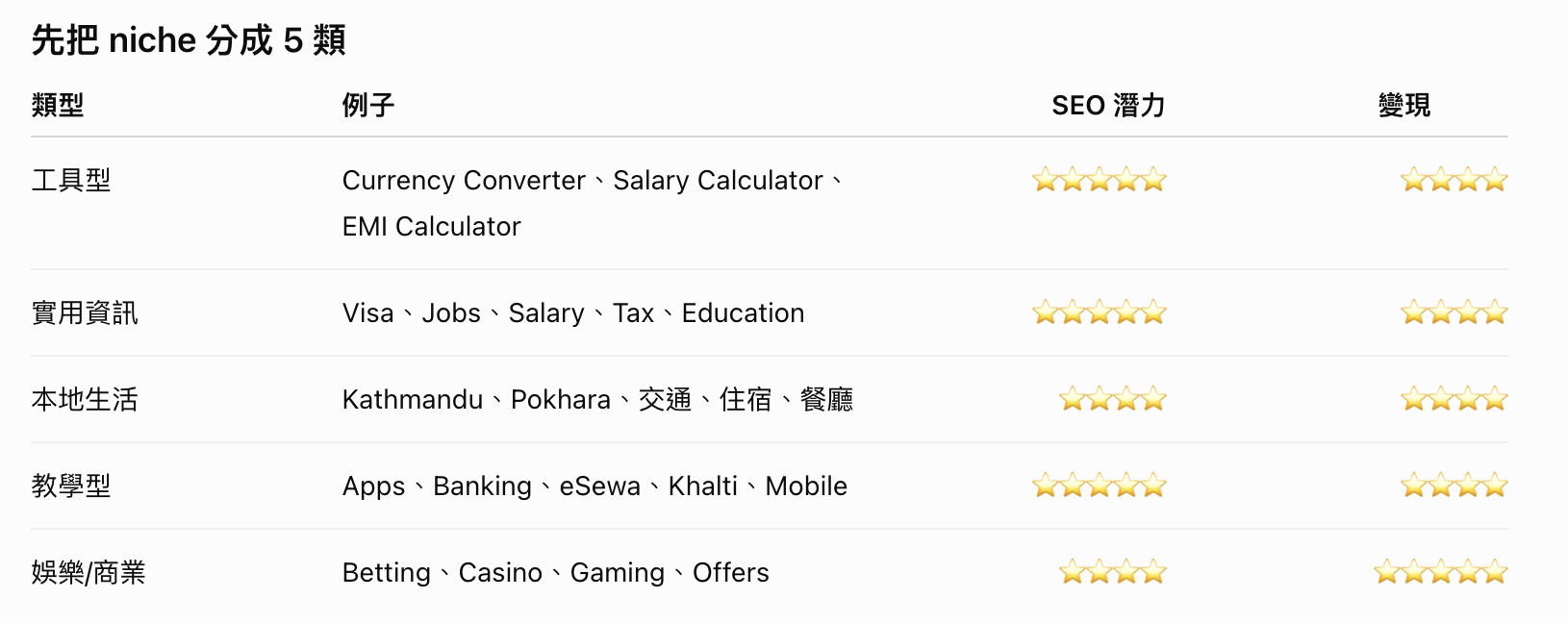
I could pick a category quickly, one that actually had potential. It also listed keywords I could aim at inside each category.
Even with that list, I still check it myself, with a keyword tool. The list is a start. The numbers make it more accurate.
Hand the data to Codex. Talk first. Do not build the files yet.
The niche pass above was in the ChatGPT website. From there I gave Codex the categories and the keyword data I needed. I run Codex through Trae, as a plugin, so the project stays in a chat.
I talk first. I don’t ask it to build the data files on the first pass. Needed and unneeded end up in the same pile, and AI likes to do too much. So I start from the material I already gave it, and I ask for one thing: a site brief.
Keyword research
Once I have the brief, I ask for a keyword list. I paste those seed keywords into a keyword tool. I use Ahrefs. I look up the real numbers: volume, KD, CPC if it is there (I do not require it), the SERP, and the parent topic or related keywords.
I feed that back to Codex. From those numbers it suggests a few seed groups to research again. Volume and KD are the basic numbers. I also attach the matching terms, and the live SERP, not just the tool’s summary. Codex can then dedupe, cluster, and build a content matrix.
The loop: pick a topic, research keywords, find seeds, decide the pages
The sequence is: pick the topic, research the related keywords, find the seed keywords that have traffic, then decide which pages to build and which sections each page needs.
After that, I can start the content. That is the loop.
Building the site is the easy part now. The logic is not.
A site is easy to start now, because of AI. Language used to be a wall, and so was not having the information. Both are easier to get past, and I can cover more of the market than I used to.
The steps are not the hard part. What matters is having a logic I can repeat. A loop like this can become a workflow, and then I can build the next site the same way.
The rest of the AI notes are still in Chinese, on the AI workflow shelf.


Write me
Email is enoughIf a step here does not match what you are seeing, or you got stuck halfway, email me. The subject already has this note's title, so I know which one you mean.